Manos Antoninis, Global Education Monitoring (GEM) Report and Prof. Aaron Benavot & Prof. Marcia McKenzie, MECCE Project
Education systems worldwide are adapting to prepare younger generations for tackling the environmental and climate challenges that increasingly shape our future. A new indicator has been developed and absorbed into the SDG global indicator 4.7.1, which measures how countries are integrating ‘green’ content into their curricula. This blog explains how this greening curriculum indicator was prepared and why it is important.
How Did this Indicator Come About?
The greening curriculum indicator seeks to evaluate how thoroughly environmental themes are woven into primary and secondary education. It is based on the understanding that concepts related to sustainability, environment, climate change and biodiversity should influence teaching and learning processes comprehensively, rather than exist as a separate subject. It connects curriculum content to tangible outcomes such as student knowledge and country fulfilment of SDG and UN Framework Convention on Climate Change commitments.
Following the UN Transforming Education Summit in 2022, the SDG 4 High Level Steering Committee decided to add new indicators to measure the summit’s outcomes, including on ‘greening education’ as reflected in the work of the Greening Education Partnership. It requested the GEM Report and UIS to coordinate the efforts.
Up to that point, SDG global indicator 4.7 on sustainable development had one indicator measuring. the ‘Extent to which (i) global citizenship education and (ii) education for sustainable development are mainstreamed in (a) national education policies; (b) curricula; (c) teacher education; and (d) student assessment, which had been measured with self-reported country data, raising questions of validity and reliability.
A proposal for an indicator that would offer an objective source of information for one dimension (sustainable development) and one intervention (curriculum) of SDG global indicator 4.7.1 was constructed by the Monitoring and Evaluating Climate Communication and Education (MECCE) Project and the GEM Report in coordination with UNESCO.
How the Greening Curriculum Indicator Fits into the SDG Global Indicator 4.7.1
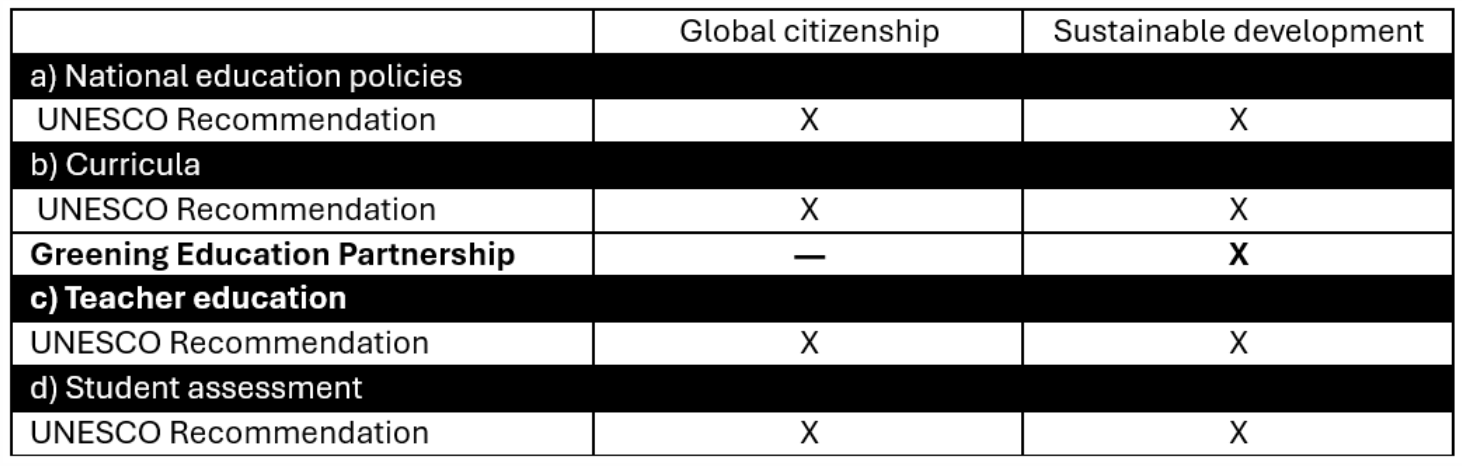
The proposal was first submitted to the Education Data and Statistics Commission (EDSC) in July 2024 and EDSC members approved the proposal. Subsequently, it was presented to the Inter-Agency and Expert Group on SDG Indicators (IAEG-SDGs) in October, 2024, which decided to endorse it as part of indicator 4.7.1 in the 2025 Comprehensive Review, the second and final review of the SDG monitoring framework.
What Does the Indicator Measure?
The indicator focuses on three themes:
- Environment and sustainability
- Climate change
- Biodiversity
For each theme, 4-5 representative keywords were selected based on their relevance, translatability and prevalence. As per the table below, these include terms like environment(al), sustainability, climate change, greenhouse gas, biodiversity and ecosystem. The keywords have been translated into 40 languages and validated by experts. These words are aligned with the Greening Education Partnership’ curriculum guidance and its focus on six key concepts – climate science, ecosystems and biodiversity, climate justice, resilience-building, post-carbon economies, and sustainable lifestyles.
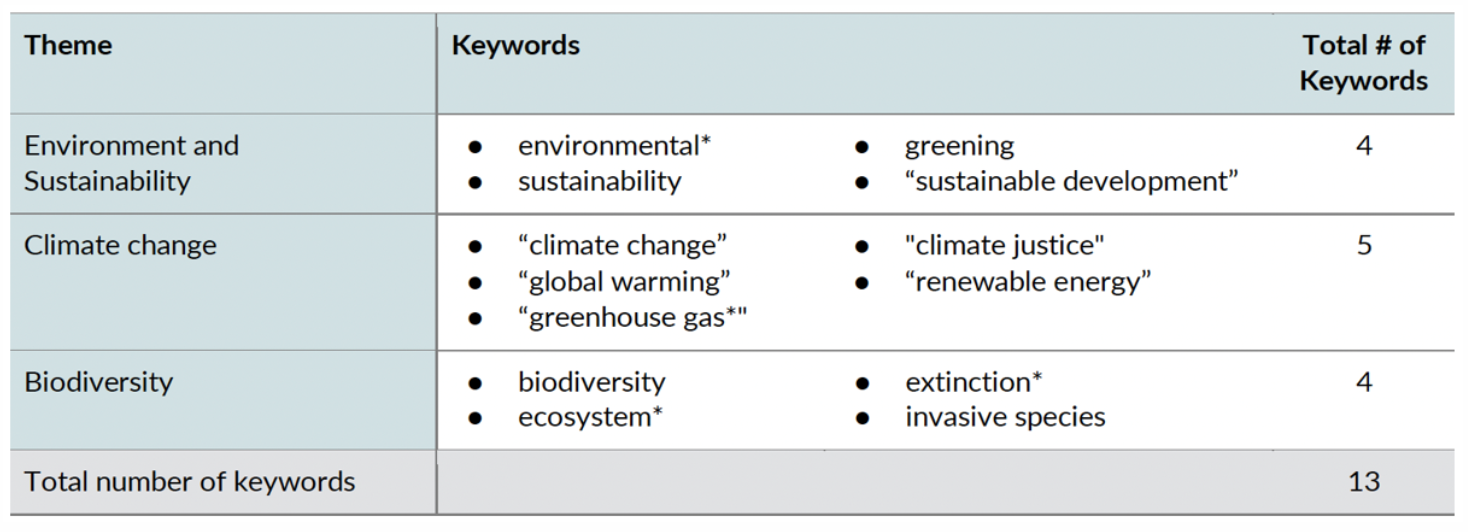
The coverage of these keywords is measured in two types of documents:
- National curriculum frameworks (outlining curriculum-related aims, philosophy, structures, guidelines)
- Subject curricula/syllabi in science and social science domains
The analysis covers grades 3, 6 and 9, examining up to four subjects per domain. Countries are included if they have at least three of the four main document types required.
The first presentation of the data for 90 countries was reported in the GEM Report and MECCE Report, Learning to Act for People and Planet in 2024. Subsequent analysis covers 110 countries, of which 29 are missing one of the four target documents. The global average score is 40 out of 100, with a median of 43 and scores ranging from 9 to 66.
The analysis suggests four key findings:
- Environment and sustainability content in integrated much more frequently in curriculum documents than climate change and, especially, biodiversity content.
- All topics are covered more extensively in grade 9 than in grade 6 or 3.
- Coverage of green content in national curriculum frameworks is not correlated with coverage in syllabi, suggesting different intentions and preparation processes for the respective documents.
- Green content is more prevalent in documents published after 2015 than in those published before that year.
Why this Indicator Matters
The greening curriculum indicator provides education policymakers and other interested parties with concrete data to assess how well the respective themes are being integrated into national education systems. By identifying gaps in current curricula, particularly in climate change and biodiversity education, countries can make targeted improvements to enhance the knowledge, skills and attitudes of students and better prepare them for environmental challenges.
In the coming weeks, all countries will be invited by UNESCO to contribute their up-to-date curriculum documents to ensure that the latest materials are included in a planned mapping exercise in 2026.
The indicator offers an informative tool for tracking global progress toward building environmentally literate generations capable of creating sustainable solutions and mitigating the effects of climate change. Discussions about the indicator, and how to ensure it aligns with existing global efforts and initiatives to green education are ongoing. We look forward to country and other partners’ engagement so that the indicator can better support their advocacy efforts.
This article is republished from The World Education Blog with permission from the Global Education Monitoring Report. Read the original article.
How can I learn more?
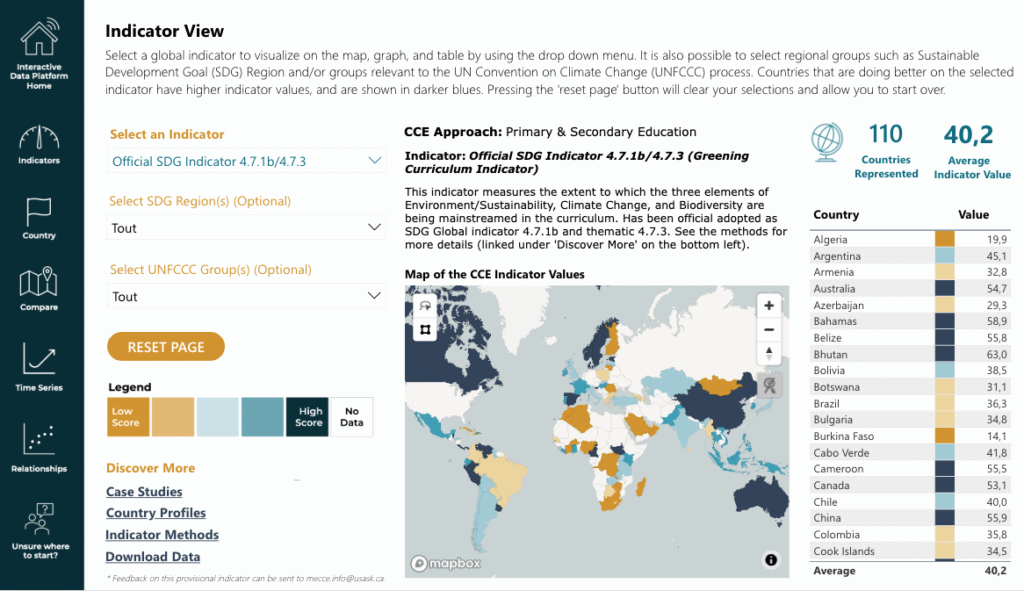
Data from Global Sustainable Development Goal Indicator 4.7.1b are available on the interactive data platform. The indicator analysis tool allows users to analyze and visualize the SDG indicator, as well as by national curriculum frameworks, primary education curricula, and secondary education curricula.
About the AuthorS

Manos Antoninis has been the Director of the Global Education Monitoring (GEM) Report since 2017, having been previously responsible for the monitoring section of the report. He participates on the MECCE Project’s Advisory Council. Dr. Antoninis coordinated the financing gap estimates for the 2030 education targets, the projections on the achievement of universal primary and secondary education completion, and the World Inequality Database on Education. He represents the report team in the Education Data and Statistics Commission, of which he is currently co-chair. Prior to joining the team he worked for 10 years on public finance, monitoring and evaluation projects in education including: a public expenditure tracking and service delivery survey of secondary education provision in Bangladesh; the evaluation of a basic education project in the western provinces of China; the mid-term evaluation of the Education For All Fast Track Initiative; the annual reporting of progress in the implementation of the Second Primary Education Development Project in Bangladesh; a basic education capacity building programme in six states in Nigeria; the evaluation of an in-service, cluster-based teacher training programme in Pakistan; and the country study of the Out of School Children Global Initiative in Indonesia. He holds a DPhil in Economics for a study of technical education and the labour market in Egypt, completed at the Centre for the Study of African Economies of the University of Oxford.

Aaron Benavot is with MECCE Project partner, University at Albany – State University of New York. He leads the MECCE Project’s Indicator Development Axis, sits on the MECCE Project’s Steering Council, and Leads the project’s Indicator Expert Group and Indicator Working Group. He is also a Professor of global education policy in the School of Education at the University at Albany-SUNY. Aaron has co-authored/edited five books and is a contributing author on many UNESCO reports. From 2014-2017, Aaron served as Director of the Global Education Monitoring (GEM) Report. Its mandate is to monitor progress of education targets in the 2030 Agenda for Sustainable Development; consider effective policies to achieve quality, equitable and inclusive education and lifelong learning; and promote informed dialogue on education’s role in achieving sustainable development. As Director, Aaron oversaw the development of three reports — Education for all: 2000-2015: Achievements and challenges (2015); Education for people and planet: creating sustainable futures for all (2016); and Accountability and Education: Meeting our commitments (2017/8).

Marcia McKenzie Professor and Associate Dean Sustainability in the Faculty of Education, University of Melbourne. She is Director of the Monitoring and Evaluating Climate Communication and Education (MECCE) Project (www.mecce.ca), University of Saskatchewan. Her research areas include global education policy research, geographies of education, and climate and sustainability education, including in relation to place, mobilities, and affect theory. She is co-author/editor of six books, including Researching Global Education Policy: Diverse Approaches to Policy Movement (Policy Press, 2024) and Navigating the Research-Policy Relationship: Studies in Environmental and Sustainability Education (2024, Routledge); and co-edits the book series Lobal Global Issues in Education (Routledge) and Studies in Education and the Environment (Palgrave).
Acknowledgements
The data for this indicator were in part developed thanks to commissioned studies with and for UNESCO. The MECCE Project’s indicator development is led by Prof. Aaron Benavot, Director Prof. Marcia McKenzie, Research Coordinator Dr. Aaron Redman, and Senior Project Manager Nicola Chopin. We are grateful to the GEM Report and the UNESCO Institute for Statistics for championing the indicator with the SDG4 Education Data and Statistics Commission and Inter-Agency and Expert Group on SDG Indicators, which accepted this as a new Global Indicator for SDG 4.7.1b and a Thematic Indicator for SDG 4.7.3.
Many thanks to colleagues at UNESCO and the MECCE Project team members who collaborated on the development and design of the indicators. This particularly includes members of the MECCE Project Advisory Committee, Axis 2 Expert and Working Groups, and colleagues who conducted detailed reviews of the indicators. We are also grateful to Dr. Kristen Hargis, Shreelakshmi Subbaswamy, and Soojeong Ahn for their coordination work on the contributing UNESCO studies. Many thanks also to Research Assistant Diego Posada for his contributions to building the NCF database.