


In November 2025, the 30th meeting of the Conference of the Parties (COP) was held in Brazil. During annual COPs, countries negotiate targets and plans for reducing greenhouse gas emissions across sectors. This includes through climate communication and education, as a component of both the original UN Climate Change Convention (1992) and the Paris Agreement (2015).
As part of the COP, the MECCE Project:
- Released a new round of case study reports of innovative climate communication and education.
- Published a blog post on the new SDG Global Indicator 4.7.1b on the World Education Blog.
- Was cited by UNESCO in a new urgent call to accelerate the greening of schools world wide.
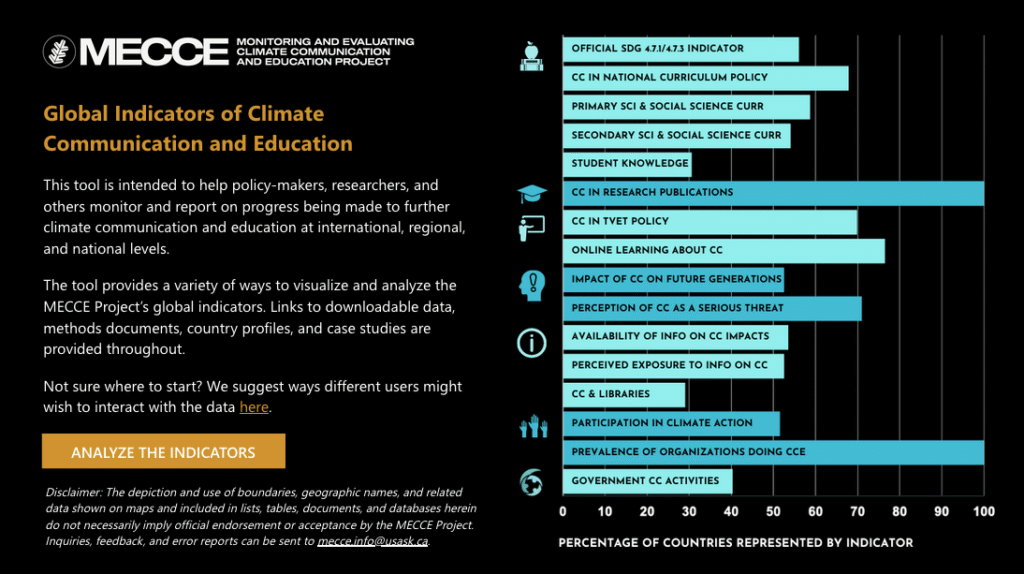
- Launched updates to the MECCE Project’s interactive data platform and global indicator data, including being able to navigate the platform as a policy maker, researcher, or practitioner, with different functionalities to suit varied needs.
- Published a new brief analyzing greening education content in 133 countries’ National Curriculum Frameworks and and 166 countries’ Nationally Determined Contributions.
- Presented at the launch of the UNESCO Greening Education Partnership’s Greening Communities Guidance on November 14.
FUNDED CASE STUDIES REPORTS
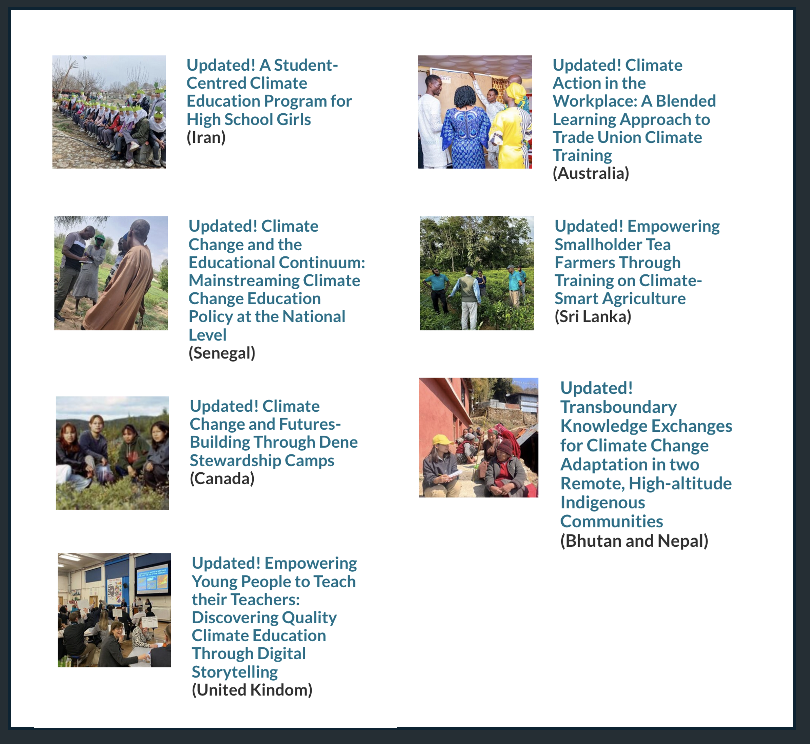
We are excited to announce that final reports from another round of funded case studies of quality CCE are now available! The case studies explore quality CCE approaches around the world–in schools in Iran and the United Kingdom, on Sri Lankan smallholder tea farms, on the land in a Canadian First Nation, across the Senegalese education and training system, and on trade unionists’ computers around the world. These case studies highlight the important role quality CCE plays in fostering hope, empowering locally-relevant climate action, building relationships with nature, supporting livelihoods, and taking policy action. Visit the interactive data platform to view summaries, reports, photos, and videos, or the digital library to read the reports.
SDG Global Indicator 4.7.1b on the World Education Blog
Education systems around the world are transforming to prepare young people to address environmental and climate challenges. The new Sustainable Development Goal Global Indicator 4.7.1b will help track countries’ progress in greening their education systems. A new blog post on the World Education Blog explains how the new SDG Global Indicator 4.7.1b was developed and why it is important. The post was written by Director Manos Antoninis (Global Education Monitoring Report), Prof. Aaron Benavot (University at Albany-SUNY), and Director Marcia McKenzie (University of Melbourne), who are all MECCE Project team members. The blog is also cross-posted on the MECCE Project’s Global CCE Blog.
UNESCO Uses MECCE Project Data In Call for Urgent Action to Accelerate Greening of Schools
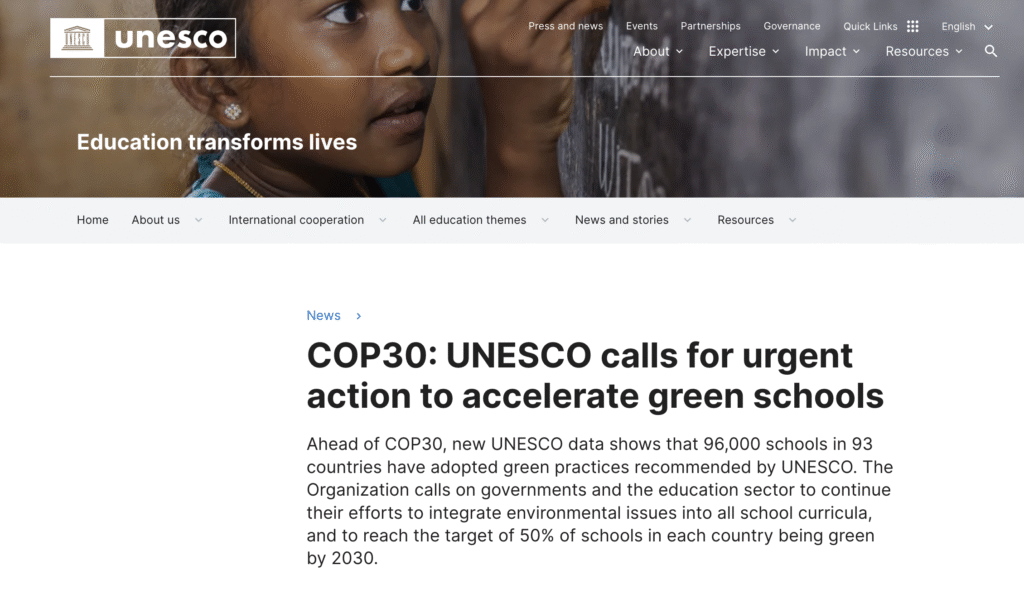
As part of COP activities, UNESCO cited MECCE Project data to support a new call urging governments and the education sector to strengthen integration of environmental and climate change content into all school curricula. The data are reported in a new MECCE Project research brief that shows that the overall depth and breadth of green content in national curricula remains low.
New Global Indicators
Data from Global Sustainable Development Goal Indicator 4.7.1b is now available on the interactive data platform. This indicator was developed by the MECCE Project in partnership with the Global Education Monitoring Report and UNESCO Institute for Statistics, and recently formally accepted by the UN. It measures greening content in countries’ national curriculum frameworks and grade 3, 6, and 9 science and social science curricula. The indicator analysis tool allows users to analyze and visualize the SDG indicator, as well as by national curriculum frameworks, primary education curricula, and secondary education curricula. We have also added an in-development indicator of the extent of education commitments in the action plans countries submit under the Paris Agreement, which are known as Nationally Determined Contributions. We welcome feedback on this provisional indicator.
Research Brief: An Analysis of National Curriculum Frameworks and Nationally Determined Contributions
This research brief shares results of an analysis of greening education content in two types of high-level policy: 1) National Curriculum Frameworks (NCFs) from 131 countries were analyzed for greening content, and 2) Nationally Determined Contributions (NDCs) from 193 countries were analyzed for education/training content. The NCF data are from Sustainable Development Goal Global Indicator 4.7.1b, which tracks country progress towards greening NCFs and science and social science subject curriculum for grades 3, 6, and 9. The findings on NCFs suggest that countries can make greater strides to green their curricula, particularly by including climate change and biodiversity content. The findings on NDCs suggest that inclusion of education/training content is relatively shallow, with few references to specific education/training types and actions. Achievement of the Paris Agreement targets will require countries including more specific, ambitious, education/training ambitions in NDCs.
Launch of the UNESCO Greening Education Partnership’s Greening Communities Guidance
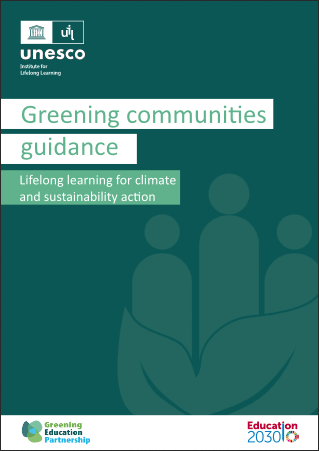
On November 14, the UNESCO Greening Education Partnership’s Greening Communities Guidance! The Guidance provides advice for municipal and civil society actors on how to ‘green’ communities by systemically integrating locally relevant, quality climate education for learners of all ages and walks of life. The MECCE Project recently collaborated with the UNESCO Institute for Lifelong Learning to edit the Guidance document. As part of launch events, Senior Project Manager Nicola Chopin presented on how communities can develop green learning strategies using the Guidance’s action planning tool.
Connect & Media Enquiries
Marcia McKenzie
MECCE Project Director
marcia.mckenzie@unimelb.edu.au
Susie Ho
Knowledge Mobilization Lead
susie.ho@monash.edu
Nicola Chopin
Senior Project Manager
nicola.chopin@usask.ca
We are grateful to the MECCE Project research team, including partners and collaborators, staff, Research Associates, and for the hard work to prepare our research and outputs for COP30.
MORE ABOUT MECCE
Funded Case STudies

GLOBAL CCE BLOG
We discuss emerging issues in climate communication and education, drawing on our findings, as well as material from other projects and sources.

REGIONAL HUBS
Learn how to join our growing global network, which supports regional input and action on climate communication and education.

DIGITAL LIBRARY
Visit our open access repository for project materials, including policy briefs, factsheets, guidelines, infographics, reports, and videos.