Case Study Summary
Sustainable Bamboo Construction Workshop Schools
Country: Ecuador
CCE Approaches: Training, Public Awareness
According to the United Nations Environment Programme, the construction sector accounts for 37% of global emissions. Up to 50% of these are from the carbon footprint of the materials used to make the buildings themselves. The transition to sustainable building materials is therefore vitally important for mitigating climate change. Bamboo is considered an ideal material for climate-friendly construction due to being fast-growing, self-regenerating, strong, naturally straight, insulating, and having relatively low management needs.
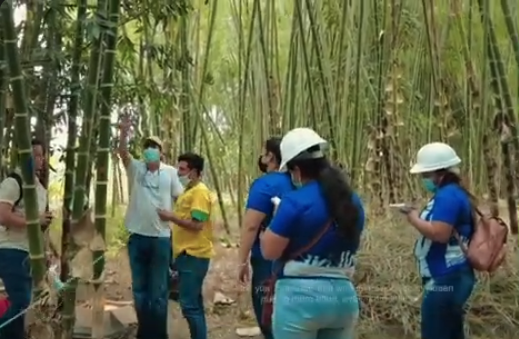
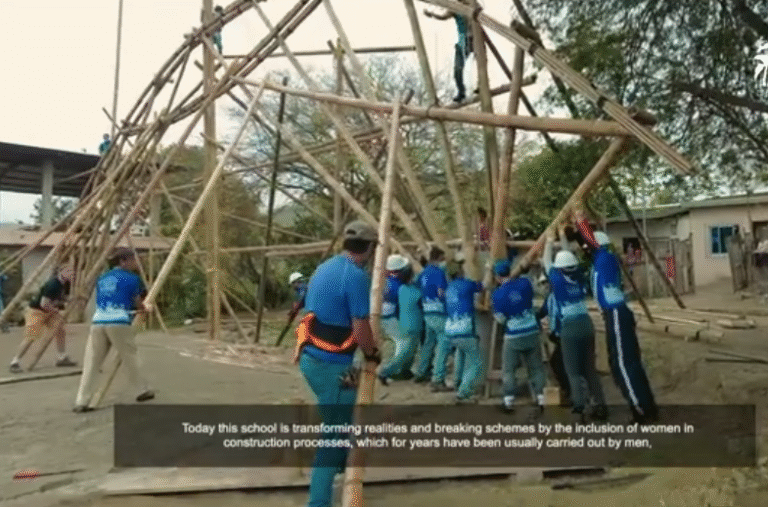
The Manabí Workshop School trains students and experienced construction professionals on climate-smart construction using bamboo. The school has the dual aim of educating students about climate change while also providing communities with a valuable resource that can contribute to the local economy. Students who participate in the year-long program learn about sustainable construction, including disaster-resistant construction, solar power installation, and bioclimatic construction with sustainable materials. The Manabí Workshop School runs with the support of the International Bamboo and Rattan Organization (INBAR).
This case study aims to understand the impact of the Manabí Workshop School on graduates, staff, and community members across different levels and sectors on society. Key informant interviews with program staff, graduates, and relevant experts will provide insights into the program’s objectives, methodologies, and perceived impacts. A stakeholder mapping will visually represent the roles, interests, and potential contributions of a variety of stakeholders to direct and indirect project outcomes, and collaborative ripple effect mapping workshops will illustrate the broader direct and indirect societal impacts of the training. Visual data (photos and videos) will also be collected during site visits.
This case study will provide important information about the convergences between climate change education, the use of locally available sustainable resources, and livelihood development in the construction industry. Those interested in integrating education, practical application, and community engagement to address climate challenges will find this case study relevant.
Featured Image Source: Chuttersnap from Unsplash
More about the MECCE Project

REGIONAL HUBS
Learn how to join our growing global network, which supports regional input and action on climate communication and education.

GLOBAL MONITORING TOOLS
We are developing interactive open access tools will offer users the ability to interact with and visualize the MECCE Project’s data.

GLOBAL CCE BLOG
We discuss emerging issues in climate communication and education to respond to the area's rapidly evolving policy environment and public discourse.

DIGITAL LIBRARY
Visit our open access repository for project materials, including policy briefs, factsheets, guidelines, infographics, reports, and videos.