The Monitoring and Evaluating Climate Communication and Education Project
Read the Report from our Latest UNESCO Consultancy
There is an urgent need to address climate change and sustainability in primary education. Learners must understand the climate impacts in their own contexts, how these issues may affect them and their communities, and how action can be taken to contribute to more sustainable, equitable, just and climate-resilient societies. Policy and curriculum are key to ensuring climate change and sustainability are addressed in primary schools.
The findings from this study, which analyzes over 830 Grade 3 and Grade 6 science and social science curricula from 88 countries worldwide, indicate that accelerated efforts are needed to green curriculum in primary school settings.
The case studies explore quality CCE approaches around the world–in schools in Iran and the United Kingdom, on Sri Lankan smallholder tea farms, on the land in a Canadian First Nation, across the Senegalese education and training system, and on trade unionists’ computers around the world. Thee case studies highlight the important role quality CCE plays in fostering hope, empowering locally-relevant climate action, building relationships with nature, supporting livelihoods, and taking policy action. Visit the interactive data platform to view summaries, reports, photos, and videos, or the digital library of completed funded case studies, and read about in-progress case studies.
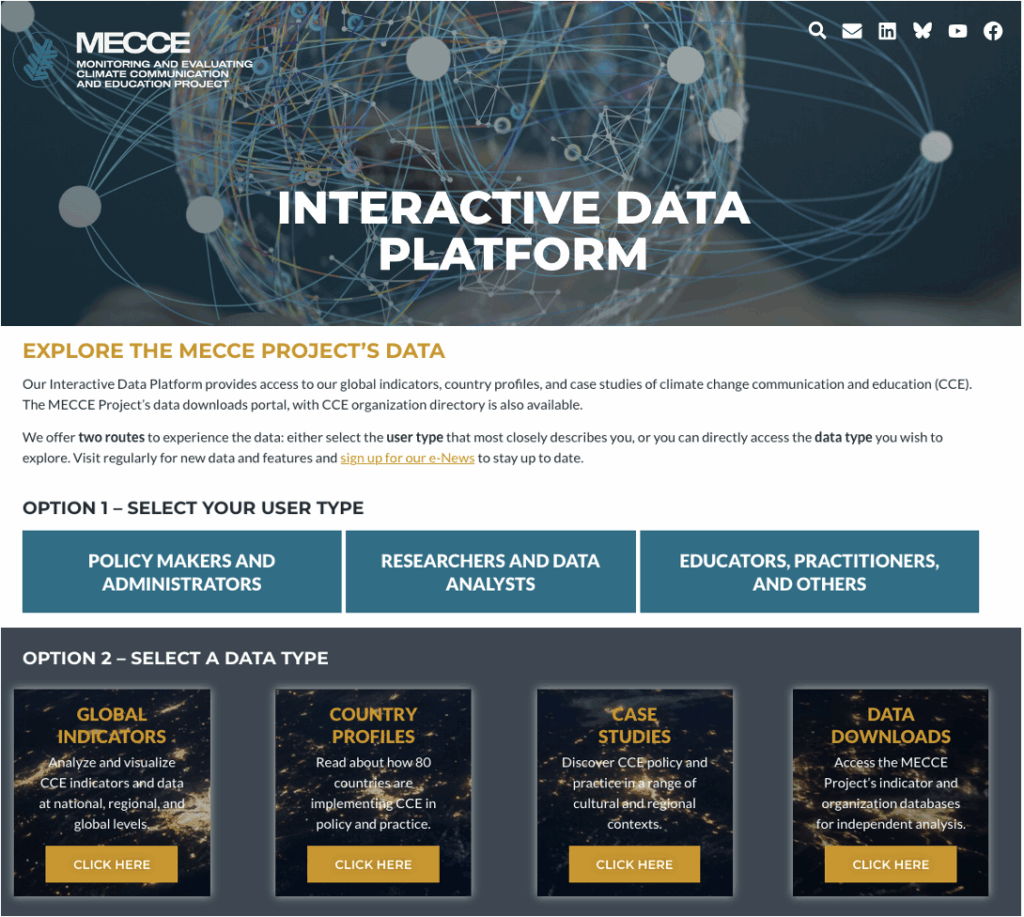
Visualize, analyze, and access the MECCE Project’s global indicators, country profiles, and case studies data. We offer two routes to navigate the platform: policy makers, researchers, and practitioners can receive recommendations about different features that may be of interest; or access the data directly by selecting a data type. We update the platform regularly with new data and features so visit often.
Places, Communities, Stories: A case studies video
While there is no one-size-fits-all approach to quality climate communication and education (CCE), an analysis of a global series of MECCE Project case studies shows us there are shared characteristics. Learn more in our video.
The MECCE Project is an ambitious international research partnership of over 100 leading scholars and agencies. Our goal is to advance global climate literacy and action through improving the quality and quantity of climate change education, training, and public awareness.
The MECCE Project’s Global CCE Blog focuses on emerging issues in climate communication and education. We draw on our findings, as well as material from other projects and sources, torespond to the rapidly evolving policy environment and public discourse on climate communication and education.
Created in partnership with UNESCO GEM Report, the country profiles provide insight on national CCE strategies, legal frameworks, budgets, and policy and programming. The profiles are validated by country experts, such as ACE Focal Points, and support policy coherence and peer learning through analysis of areas for policy prioritization to advance ACE progress. We have now published 80 Country Profiles of CCE in partnership with the UNESCO GEM Report. The countries covered represent all levels of climate vulnerability, income/development, and SDG regions. They are also home to 75% of the global population.
The detailed country profiles offer a comparative perspective of country progress on ACE and Sustainable Development Goal (SDG) Targets 4.7 and 13.3.
We use cookies to improve your experience on our site. By using our site, you consent to cookies.
This website uses cookies
Websites store cookies to enhance functionality and personalise your experience. You can manage your preferences, but blocking some cookies may impact site performance and services.
Essential cookies enable basic functions and are necessary for the proper function of the website.
Name
Description
Duration
Cookie Preferences
This cookie is used to store the user's cookie consent preferences.